
_edited.png)

Defining School Event Entertainment for Organizers


School event entertainment is a designed, participatory experience built to extend learning, build community, and engage students actively rather than fill time with passive performances. The industry term for this approach is event experience design, and it marks a clear shift from simply booking a performer to crafting a full event arc. Defining school event entertainment today means understanding that every activity, transition, and moment on the program serves a purpose. Parents and school organizers who grasp this distinction plan events that students talk about for months, not just the rest of the afternoon.
What key elements define effective school event entertainment?
Effective school event entertainment is built on participation, not observation. When students are active in the experience rather than watching from bleachers, engagement stays high and the event leaves a lasting impression. Event designers and education specialists consistently point to several core elements that separate impactful programming from forgettable filler.
The strongest school entertainment programs share these characteristics:
Interactive participation. Students move, respond, vote, or perform rather than sit passively. Hands-on involvement is the single biggest predictor of post-event retention.
Age-appropriate content. A program designed for fifth graders will not land with high school juniors. Developmental stage shapes attention span, humor, and the type of challenge that feels rewarding.
Alignment with learning goals. Arts programs in 2026 schools tie music, theater, digital media, and visual arts directly to curriculum and mental health outcomes. Entertainment that mirrors classroom themes reinforces learning instead of interrupting it.
High-throughput activities. Inflatables, carnival games, and group challenges keep energy moving by engaging multiple students at once. Single-user setups create lines and dead time.
Cultural relevance. Programming that reflects the school’s community, values, and local identity connects more deeply with students than generic touring shows.
A narrative or thematic arc. The best events have a beginning, middle, and end that feel connected. A science fair with a mystery theme, or a spring celebration tied to student art projects, gives the day a shape students can follow.
Follow-up integration. Teachers who receive discussion guides or activity prompts after an event can extend its impact into the classroom the next day.
Pro Tip: Ask your entertainment provider for a one-page teacher follow-up guide before you sign a contract. If they cannot provide one, the program is probably not designed with learning in mind.
The purpose of school entertainment is not to reward students with a break. It is to create shared experiences that build school culture and reinforce the values the staff works to instill every day.

How does designed school event entertainment differ from traditional entertainment shows?
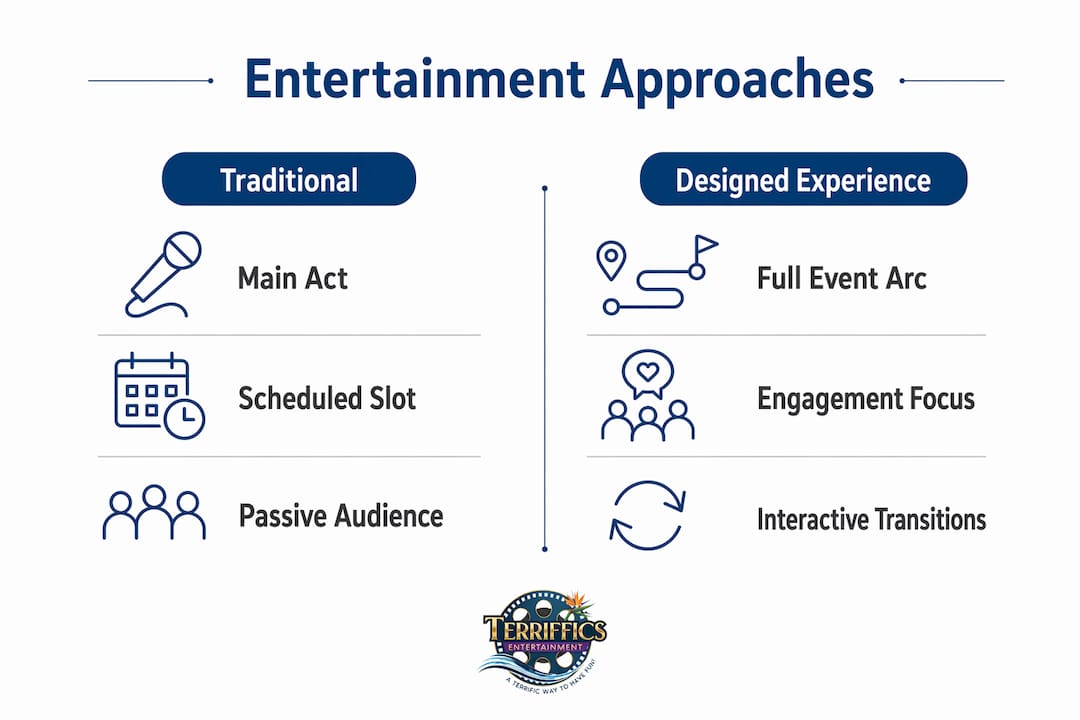
Traditional school entertainment means booking a performer and handing them a time slot. Experience design means mapping the entire event from the moment students walk in to the moment they leave. The difference is significant, and it shows up clearly when you compare the two approaches side by side.
Factor | Traditional entertainment show | Designed experience |
Focus | The main act | The full event arc |
Transitions | Unplanned gaps | Music, lighting, and cues between segments |
Student role | Audience member | Active participant |
Emotional arc | Flat or random | Builds toward a peak moment |
Follow-up | None | Teacher guides, artifacts, shared narratives |
Fit for age group | Generic | Tailored to developmental stage |
Designing transitions with music, lighting, and audience cues is as vital as the main attraction itself. A poorly managed five-minute gap between acts loses the room faster than a weak performer. Event architects treat those connective moments as part of the program, not as downtime.
One-size-fits-all big productions often underperform at school events for a specific reason. They are built for adult attention spans and adult humor. K-8 students require short, interactive content bursts to maintain engagement. Compressing an adult-event format into a school gym does not work. It frustrates students and wastes the organizer’s budget.
High school events carry different needs. Older students respond to peer scenarios, humor that respects their intelligence, and formats that give them agency. A trivia competition, a student talent showcase, or a DJ-driven dance event works because students feel ownership over the experience. The format respects where they are developmentally.
The shift from hiring entertainment to designing an experience is the most important concept in planning school events in 2026. Organizers who make this shift stop asking “Who can we book?” and start asking “What do we want students to feel and remember?”
What are the most popular types of school event entertainment in 2026?
School event activities have expanded well beyond the traditional assembly or talent show. The formats that generate the most engagement today combine technology, arts, and physical participation in ways that feel fresh to students.
The most effective options currently include:
Interactive science and storytelling assemblies. Performers who deliver 400 or more shows yearly adapt their content to specific age groups and learning themes. These programs work because they blend humor, peer scenarios, and active participation rather than relying on production scale.
Arts performances tied to social-emotional learning. Music, theater, and visual arts programs foster creativity and mental health alongside academic enrichment. A live drumming circle or a student-led mural reveal gives the event emotional weight.
School musicals and drama productions. School musicals build collaboration, responsibility, and confidence over weeks of rehearsal. The performance itself is the payoff, but the real value is the social and emotional growth that happens during the process.
Carnival-style games and inflatables. These work best at end-of-year celebrations, field days, and fundraisers. They keep large groups moving and engaged without requiring a single focal point.
Outdoor movie nights. A school courtyard or field transformed into an outdoor theater creates a community event that families attend together. It extends the school’s reach beyond the student body.
AI-powered photobooths and DJ setups. Technology-enabled entertainment gives students a personalized takeaway. A photobooth print or a shared playlist creates a physical memory of the event.
Multi-part event arcs aligned with curriculum. A fall STEM challenge, a winter social-emotional learning reset, and a spring arts celebration form a multi-year programming arc that builds school culture over time rather than delivering isolated experiences.
The best school event ideas share one trait: students leave with something, whether that is a skill practiced, a memory made, or a conversation started.
How do you plan and measure success in school event entertainment?
Planning school entertainment starts with a clear goal, not a vendor search. Before you contact any provider, write down what you want students to feel, learn, or remember. That goal shapes every decision that follows.
Follow these steps for a well-planned school event:
Set educational and cultural goals first. Decide whether the event supports a curriculum theme, celebrates student achievement, or builds community. A goal like “students leave feeling proud of their school” is specific enough to guide programming choices.
Match entertainment to your audience and schedule. A 45-minute assembly for third graders needs a different format than a two-hour evening event for families. Pacing and attention span are non-negotiable constraints.
Plan transitions as carefully as the main program. Gaps between activities are where events fall apart. Assign a staff member to manage each transition with music, a brief activity, or a clear announcement.
Brief teachers before the event. Teachers who know the theme and content can prime students beforehand and lead follow-up discussions afterward. This doubles the event’s educational value.
Collect feedback immediately after. Rapid teacher surveys, student ambassador programs, and displaying student artifacts are the best-practice methods for measuring impact. Schools using these methods report improved morale and culture.
Build toward a multi-year arc. A single great event is a good start. A seasonal programming arc aligned to curriculum transforms events into a culture-building engine. Examples include a STEM focus in fall, a social-emotional learning reset in winter, and an arts celebration in spring.
Pro Tip: Create a one-page event brief for every school event. Include the goal, the audience age range, the schedule with transitions marked, and the follow-up plan. Share it with every vendor and staff member involved.
Measuring success goes beyond attendance numbers. The real indicators are whether students reference the event in class, whether teachers report a positive shift in mood, and whether the experience reinforced the school’s stated values.
Key takeaways
School event entertainment succeeds when it is designed as a purposeful experience with clear goals, age-appropriate content, and planned transitions rather than booked as passive filler.
Point | Details |
Define the goal first | Set a clear educational or cultural goal before selecting any entertainment format. |
Design the full arc | Plan transitions, pacing, and follow-up activities, not just the main act. |
Match content to age group | K-8 students need short interactive bursts; high schoolers respond to peer-driven formats. |
Use arts and technology | Programs tied to music, theater, and digital media build social-emotional skills alongside fun. |
Measure beyond attendance | Use teacher surveys, student artifacts, and ambassador feedback to gauge real impact. |
What we have learned from planning school events
The biggest mistake I see organizers make is treating a school event like a corporate party with a smaller budget. The instinct is to book the biggest act available and hope the energy carries the room. It rarely does.
What actually works is respecting the students in the room. K-8 kids are not a captive audience waiting to be impressed. They are active, social, and quick to disengage when content feels condescending or slow. The events that land are the ones built around their energy, not against it. Humor that acknowledges peer dynamics, challenges that let them win, and formats that give them a role to play all outperform a polished stage show every time.
The detail most organizers overlook is transitions. I have watched a genuinely great performer lose a room of 300 students during a four-minute equipment change. That gap was not in the plan, and nobody owned it. A staff member with a microphone and a quick trivia question would have held the room. Transitions are programming. Treat them that way.
The longer view matters too. One great event is a good day. A series of events tied to a school-wide theme across the year becomes part of the school’s identity. Students start anticipating them. Teachers build lessons around them. That is when school entertainment stops being a line item and starts being a culture.
— Terriffics
Terrifficsentertainment’s school event services for Oahu organizers
Terrifficsentertainment works with schools across Oahu to deliver entertainment that fits the way students actually engage. We bring the setup, the energy, and the experience so you can focus on your students.
Our photobooth rental for school events gives every student a personalized takeaway from the day. Our outdoor movie rental turns any school field or courtyard into a community theater night that families love. We also offer DJ sound and lighting, karaoke, and flexible mix-and-match packages built for school budgets and schedules. Fast setup, friendly crew, and zero stress for your team. See what we offer and get a custom quote for your next school event.
FAQ
What is school event entertainment?
School event entertainment is a designed, interactive experience that engages students while supporting educational and community-building goals. It goes beyond passive performances to include participatory activities, arts programs, and technology-enabled formats.
What types of school events benefit most from planned entertainment?
Assemblies, field days, end-of-year celebrations, school musicals, and family nights all benefit from planned entertainment. Events with a clear theme and structured transitions produce the strongest student engagement.
How do you measure the success of a school event?
Success goes beyond attendance. Best practice includes rapid teacher surveys, student ambassador takeaways, and displaying student artifacts after the event. Schools using these methods consistently report improved morale and school culture.
What is the difference between hiring a performer and designing a school event experience?
Hiring a performer fills a time slot. Designing an experience maps the full event arc, including transitions, pacing, and follow-up activities. The designed approach produces stronger engagement and longer-lasting impact.
How early should you start planning school entertainment?
Start planning at least six to eight weeks before the event. This gives you time to align the program with curriculum goals, brief teachers, and coordinate logistics including setup, transitions, and post-event feedback collection.
Recommended
Comments