
_edited.png)

How Many Speakers to Rent for Your Oʻahu Event

For most Oʻahu events, you need 2 powered mains for up to 100 guests, 4 mains plus 2 subs for 100–300 guests, and a compact line array with delay towers for 300–500 guests. Audio pros use a quick rule of thumb: 5–10 watts RMS per person for speech and 10–20 watts RMS per person for DJ or live music. Here’s how that breaks down by event type:
Up to 100 guests (small): 2 powered 12" mains on stands, 1–2 subs, basic mixer, 2 wireless mics
100–300 guests (medium): 4 powered 15" mains, 2–4 subs, mixer, delay speakers if depth exceeds 80 ft
300–500 guests (large): Compact line array (4–6 boxes per side), 4+ subs, delay towers, dedicated engineer
500+ guests: Large line arrays, multiple sub arrays, delay pairs, full power distribution
Ready to confirm the right count for your date and venue? Contact Terrifficsentertainment for a fast, on-island quote.
Key Takeaways
The right number of PA speakers for your Oʻahu event depends on guest count, venue type, program, and outdoor conditions — and sizing up is almost always the safer call.
Point | Details |
Basic speaker count rule | 2 mains for up to 100 guests; 4 mains plus subs for 100–300; line array for 300–500. |
Watts-per-person guide | Budget 5–10 W/person for speech events and 10–20 W/person for DJ or live music. |
Outdoor power adjustment | Add 30–40% more power for open-air venues — Oʻahu beach sites especially. |
Add delay speakers at 80 ft | When seating depth exceeds 80 ft from the mains, delay speakers prevent echo and dead zones. |
Terrifficsentertainment | Offers island-wide DJ/PA, karaoke, and outdoor movie packages sized to your exact venue and guest count. |
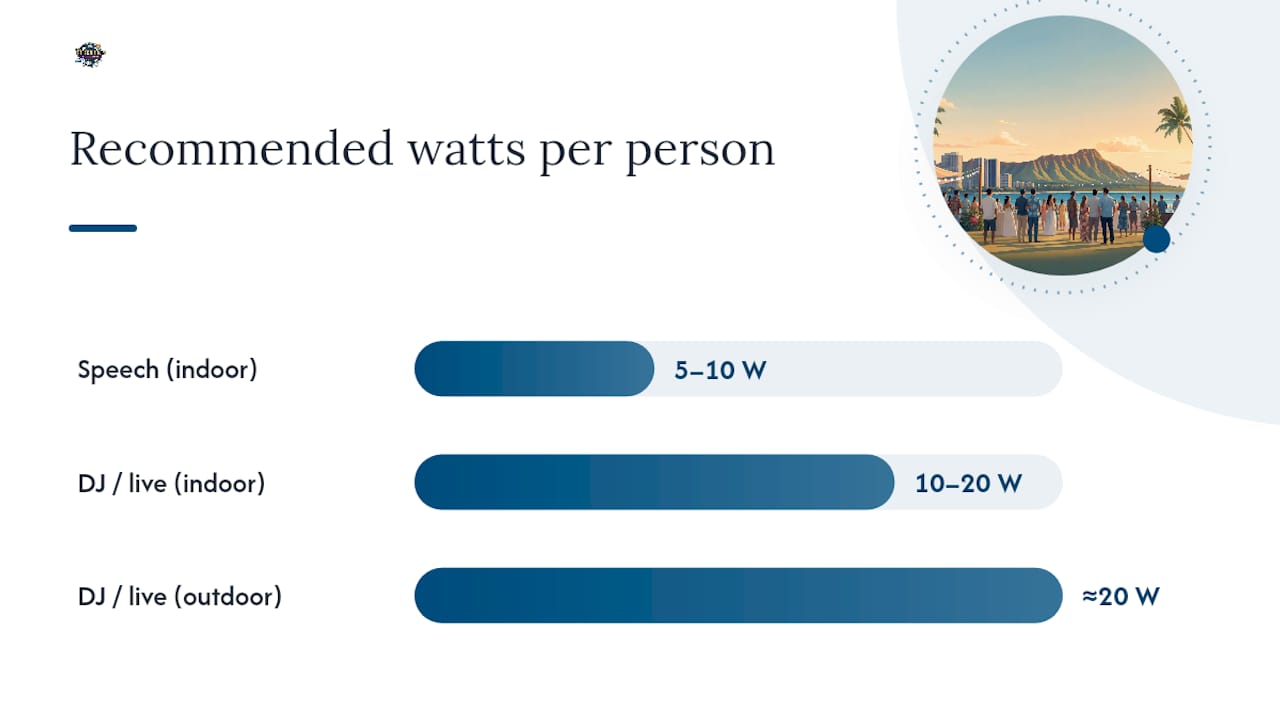
Table of Contents
What factors change how many speakers you need?
Guest count is just the starting point. These six variables can push your speaker count up or down significantly.
Audience size vs. area: Two events with 200 guests can have very different footprints. A long, narrow tent needs more speakers than a square ballroom with the same headcount. Sizing by audience area is more reliable than counting heads alone.
Indoor vs. outdoor: Walls and ceilings reflect and reinforce sound. Without them, you lose that natural boost. Outdoor setups typically need more power than an equivalent indoor event. A beachside reception on Oʻahu almost always needs bigger mains or extra subs compared to a ballroom of the same size.
Program type: Speech-only events (ceremonies, graduations) need far less power than DJ-driven receptions or live bands. Live bands add low-end energy that demands more subs and full-range mains.
Audience footprint depth: The deeper your seating runs from the stage, the harder it is for mains to cover the back rows cleanly. Add delay speakers when seating extends beyond a certain distance from the mains.
Obstacles and line-of-sight: Pillars, trees, tent poles, and walls block direct sound. Each obstacle can create a dead zone that requires a fill speaker to fix.
Ambient noise: Ocean breeze, traffic, nearby bands, or a busy hotel pool all compete with your system. Higher ambient noise means you need more headroom, not just more volume.
Pro Tip: If your event has separate zones — ceremony, cocktail hour, and dance floor — plan one speaker cluster per zone. Trying to cover three areas with one pair of mains almost always disappoints guests in two of them.
Example speaker setups by event type and guest count
Use this table as a starting point when requesting a quote. Your actual setup may shift based on venue shape and program type.
Guest Count | DJ / PA Setup | Karaoke Setup | Outdoor Movie Setup |
Up to 40 | 2x 12" powered mains, mixer, 2 wireless mics | 2x 12" mains, 1 sub, monitor, karaoke controller | 1–2 mains, projector audio out, 1 sub |
40 | 2x 15" mains, 2x subs, mixer, 2–4 mics | 2x 15" mains, 2 subs, 2 monitors, controller | 2x 15" mains, 1–2 subs, projector audio |
100–120 | 4x 15" mains, 4 subs, delay speakers if deep | 4x mains, 2 subs, monitors, 2–4 mics | 4 mains, 2 subs, possible delay fill |
300–500 | Line array (4–6 boxes/side), 4+ subs, delay towers | Line array mains, 4 subs, stage monitors | Line array or 4+ mains, 4 subs, delay |
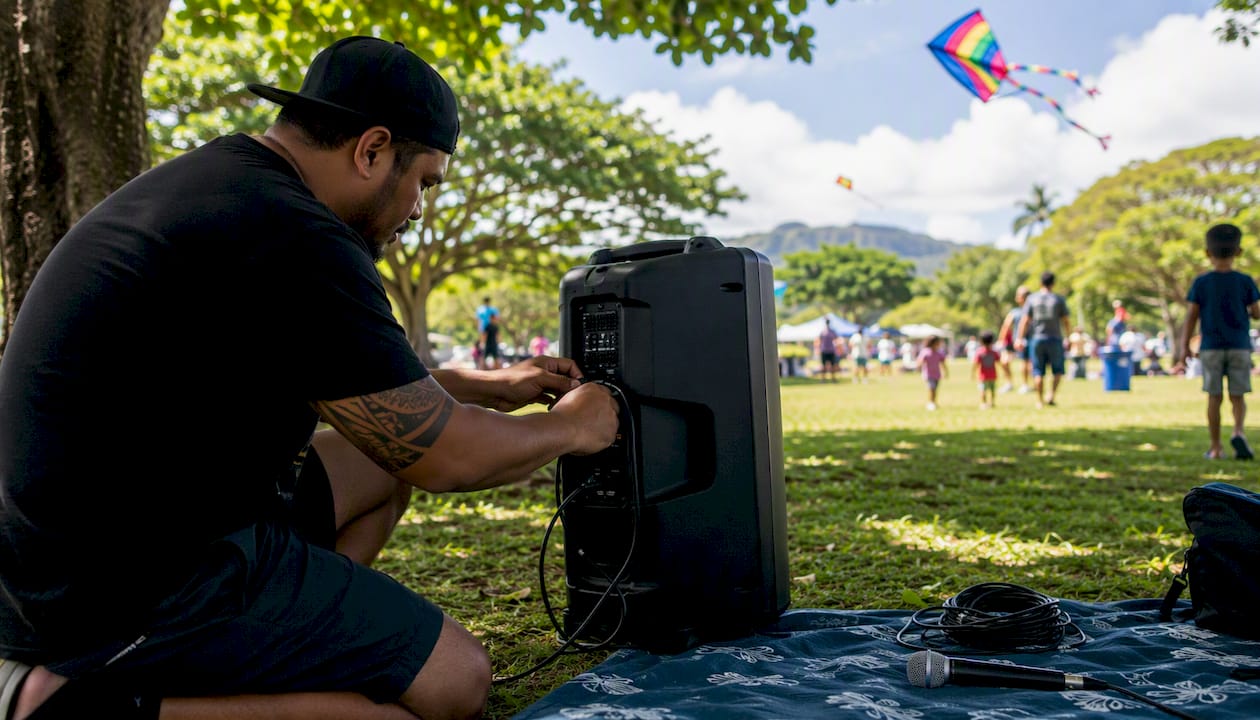
For small karaoke gatherings, monitor placement matters more than raw speaker count. At least one sub keeps vocals natural when backing tracks are bass-heavy.
Oʻahu-specific notes worth knowing:
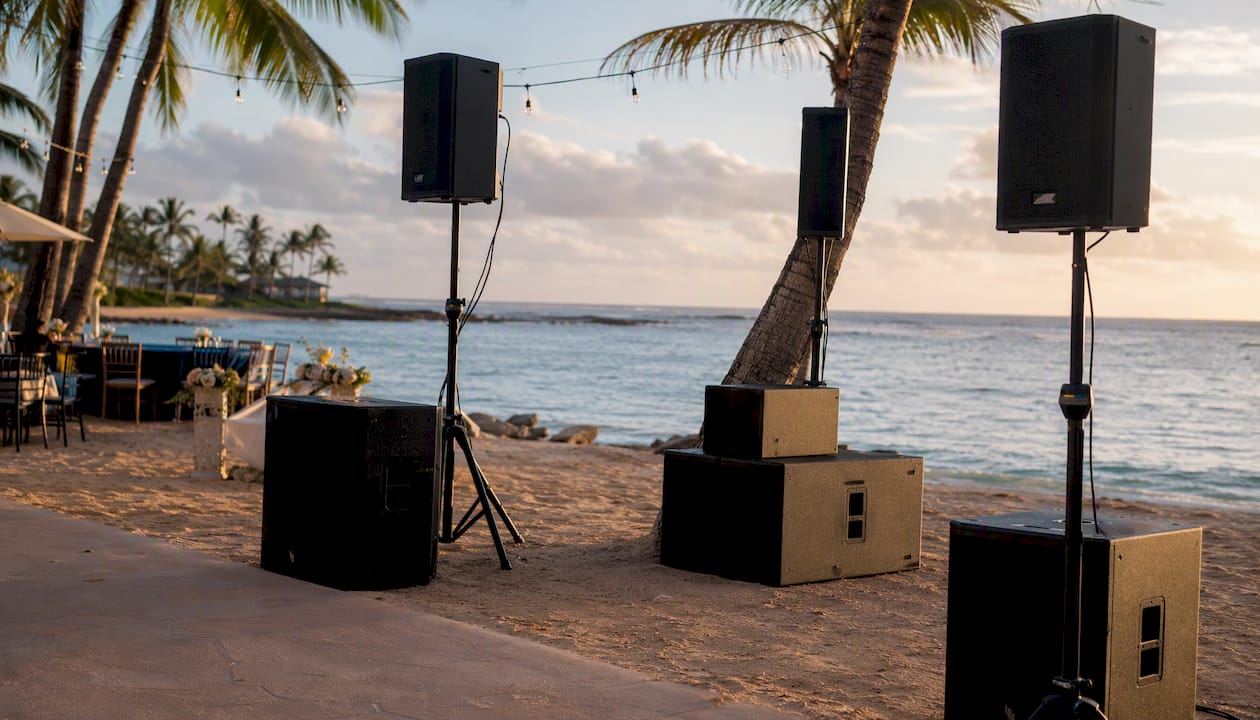
Beachside receptions: Go one tier up from the table. Wind and open air eat volume fast.
Multi-area yard events: Treat each zone separately. A cocktail area 100 ft from the dance floor needs its own pair of mains.
Ballroom vs. tent: Ballrooms reflect sound and often let you stay at the lower end of the range. Tents behave more like outdoor spaces and need the extra power to match.
Pro Tip: When you’re between two tiers, size up. Extra headroom means cleaner sound at moderate volumes — and rental providers often recommend stepping up one size when there’s any chance of live music or extended dancing.
How to estimate exactly how many speakers to ask for
Run through this checklist before you call a rental company. It takes five minutes and gets you a much more accurate quote.
Your event details:
Estimate your guest count and usable audience footprint (width × depth in feet)
Define your program type: speech only, background music, DJ, live band, or a mix
Mark any separate zones: ceremony, cocktail hour, dance floor, outdoor bar
Note ambient noise sources: ocean, traffic, nearby venues, generators
Measure the maximum distance from where mains will stand to your farthest listeners
Questions to ask your rental company:
Do you provide delay speakers, and are they included or an add-on?
How many subs come with the package, and can I add more?
Is an audio engineer or operator included, or is that a separate cost?
What are the power requirements, and do you handle cable runs and distro?
What’s the estimated setup and teardown time for my venue?
How your answers change the speaker count: a deeper footprint (over 80 ft) means delay speakers. A live band means more subs and full-range mains. Multiple zones mean a dedicated cluster per zone. For 200–500 guests, a structured line array and an on-site engineer are the standard recommendation.
Placement and setup tips that affect your coverage
Where you put speakers matters as much as how many you rent. Good placement can make a smaller system sound great. Poor placement makes even a large system feel thin.
Main speaker height and aim: Mains on stands should be elevated so the speaker cone points toward the back of the audience, not at the first row’s ears. Aim for the midpoint of the crowd. Flown arrays (rigged above the stage) give more even coverage for large rooms but require rigging points and extra labor.
Toe-in angle: Angle mains slightly inward (about 10–15 degrees) so coverage overlaps in the center of the audience area. Straight-ahead placement creates a hot center and weak sides.
Subwoofer placement: A single sub centered under or between the mains works for most events. For larger setups, two subs placed symmetrically reduce phase cancellation and even out the low end across the floor.
Delay and fill speakers: Delay speakers work by matching the timing of the sound from the mains so listeners at the back hear one coherent sound, not an echo. Place them roughly two-thirds of the way back in the audience area, aimed at the rear third.
Safety and logistics on Oʻahu: Secure all stands with sandbags or anchor straps, especially at beach or open-air venues where trade winds are a real factor. Plan cable runs along walls or under mats to avoid trip hazards. Confirm available power circuits before the event — most DJ rigs need at least two dedicated 20-amp circuits.
Pro Tip: Elevating mains by just 6–12 inches more than the default stand height often eliminates the need for a fill speaker in the front third of the room. Sound travels over heads instead of into them.
Outdoor events need 30–40% more power than indoor equivalents of the same size — a key reason Oʻahu’s open-air venues almost always call for a larger system than hosts initially expect.
What a speaker rental package includes and Oʻahu pricing signals
A standard rental package from a local provider typically covers the core gear and labor you need to run the event. Here’s what to expect:
Standard inclusions:
Powered mains and subs (quantity per your package tier)
Mixer, cables, and speaker stands
Delivery, setup, and teardown
Basic sound check before guests arrive
Common add-ons:
On-site audio engineer or operator
Delay towers or zone fill speakers
Additional wireless microphones
Dedicated ceremony PA with lavalier mics
A dedicated ceremony PA with lavalier mics is often more cost-effective than extending the reception system across two separate zones. Additional zone speakers typically run a moderate additional cost each as add-ons.
Oʻahu ballpark pricing (estimates — confirm exact quote for your date):
Event Scale | Guests | Estimated Range |
Small | Up to 100 | a few hundred to a couple thousand dollars |
Medium | 100–300 | several thousand dollars |
Large | 300–500+ | upwards of several thousand dollars |
Prices rise for weekend peak dates, holiday weekends, and remote sites that need long cable runs or generator power. For a wedding reception DJ timeline that helps you plan setup windows, Terrifficsentertainment’s blog has a detailed example.
When should you hire a professional audio setup instead of DIY?
Some events are fine with a simple Bluetooth speaker or a rented pair of mains you set up yourself. Others genuinely need a professional. Here’s how to tell the difference.
Hire a pro when:
Your guest count exceeds 150
You have a live band performing
Your outdoor site has audience depth beyond 80 ft
You need multiple zones running simultaneously
The event is a ceremony or graduation where timing and reliability are non-negotiable
You’re managing more than 2–3 wireless microphones at once
An on-site engineer handles tone control, feedback management, and real-time troubleshooting. That hands-on presence often costs less than a second rental day caused by a problem you couldn’t fix alone. Festival-scale events require engineered capacity planning with experienced engineers tuning coverage across open areas — that’s not a DIY situation.
DIY saves money on small, low-stakes events. For anything with a ceremony, a live performance, or a crowd over 150, the risk of poor coverage or feedback usually outweighs the savings.
Our perspective on Oʻahu sound from Terrifficsentertainment
On Oʻahu, the variables that trip up event hosts most often aren’t the ones you’d expect. It’s rarely guest count. It’s the 40-foot palm tree blocking the sightline to the back row. It’s the narrow driveway at a North Shore property that limits what gear we can physically bring in. It’s the trade wind that cuts volume by a third right as the ceremony starts.
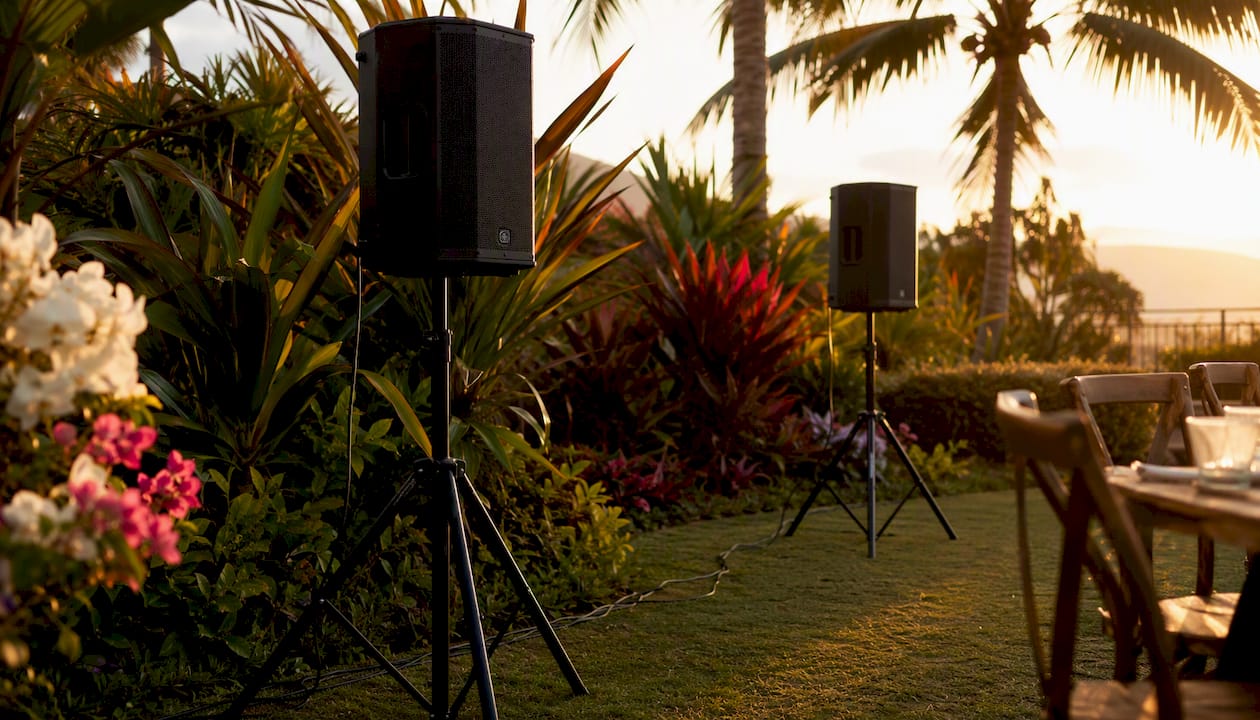
We’ve set up systems at beachside venues, multi-space backyards, school gyms, and hotel ballrooms across the island. The setups that work best are the ones we size for the actual space, not just the headcount. That’s why we ask for venue photos and a rough layout before we finalize any package. Our mix-and-match approach means you’re not locked into a fixed tier — if your venue needs two delay speakers and an extra sub, we add them. If a smaller rig genuinely covers your space, we won’t upsell you on gear you don’t need.
Fast setup and teardown matter here too. Many Oʻahu venues have tight windows between events, and we build that into every booking.
Terrifficsentertainment’s packages for Oʻahu events
Skip the guesswork on speaker counts. Terrifficsentertainment builds every package around your specific venue, guest count, and program type — DJ/PA, karaoke rental, or outdoor movie theater setup. We serve the entire island of Oʻahu from our Kapolei base, with fast setup, professional teardown, and mix-and-match flexibility so your package fits your event exactly.
To get a quote, share your event date, estimated guest count, venue name or address, and program type (DJ, karaoke, outdoor movie, or a combination). We’ll confirm availability and send you a package recommendation. For peak season weekends and holiday dates, booking 4–6 weeks ahead keeps your date secure. Request a quote or check availability today.
Sources
Recommended
Comments