
_edited.png)

What Is Event Production? A Complete Guide

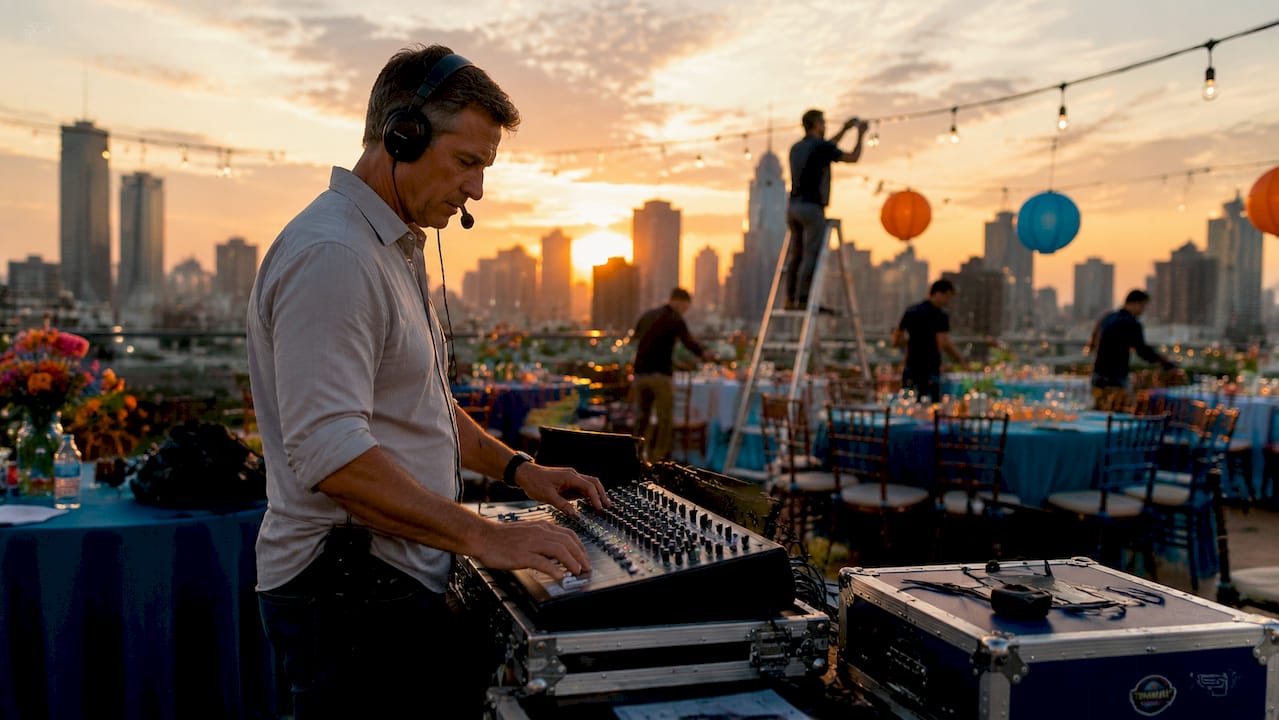
Event production is defined as the technical and creative process of transforming an event concept into a fully realized, physical experience through audio, lighting, staging, video, and set design. Most people confuse it with event planning, but the two are distinct disciplines with different goals. Understanding what event production entails is the difference between an event that runs smoothly and one that falls apart in front of your guests. Whether you are organizing a wedding in Kapolei, a corporate conference, or a school graduation, production is what makes the experience feel real and memorable.
What is event production, and why does it matter?
Event production is the technical and creative execution of an event concept, covering system design, equipment selection, crew management, and on-site technical operation. It is not a single task. It is a coordinated set of disciplines working together to deliver a live experience. Sound fails, and the speaker loses the room. Lighting is flat, and the energy drops. Video cuts out, and the presentation dies. Every one of those outcomes is a production failure, not a planning failure.
The industry term for this work is “event production,” and it covers everything from the event sound system to the rigging above the stage. Production is what the audience feels, hears, and sees. When it works well, nobody notices it. That invisibility is the goal.
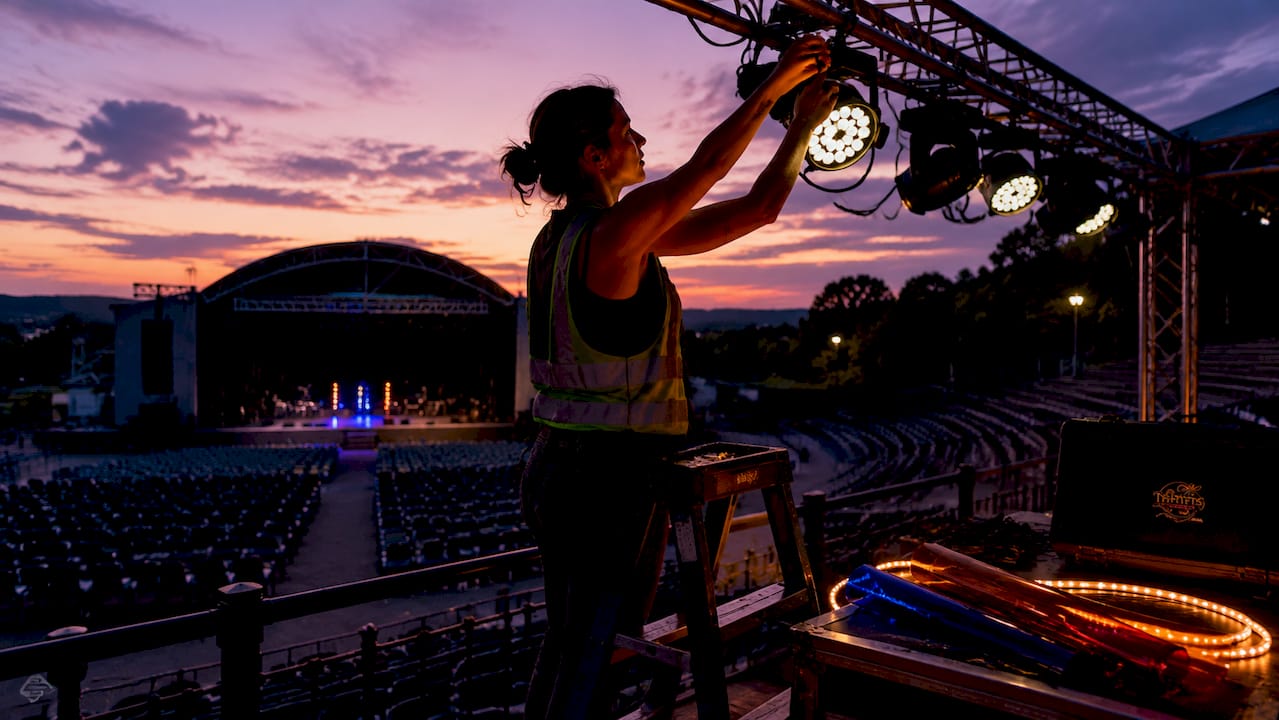
What does the event production process entail?
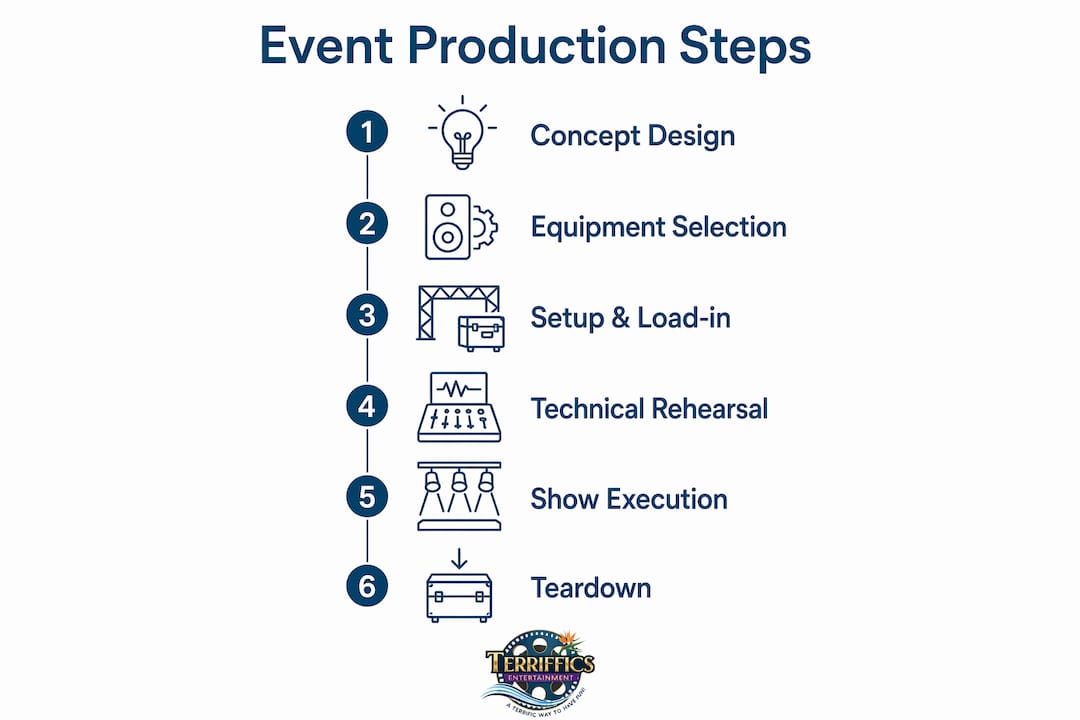
The event production process follows a phased structure. Complex events require a 6 to 12 month planning window with defined decision gates at each stage. Rushing any phase creates compounding problems on event day.
The six core phases are:
Discovery. You define goals, audience size, venue type, and budget. This phase shapes every technical decision that follows.
Concept Design. The production team builds the creative and technical vision. Audio layouts, lighting rigs, and video systems are sketched at this stage.
Prep. Equipment is sourced, crews are scheduled, and logistics are confirmed. Permits and vendor contracts are finalized here.
Load-in. Crew arrives at the venue to install and test all systems. This phase requires the most physical coordination.
Live Execution. The event runs. A technical director calls cues for lighting, audio, and video in real time.
Closeout. Equipment is struck, the venue is restored, and the team debriefs on what worked and what did not.
Two documents govern this process, and they serve different purposes. The master timeline tracks milestones across months. The run-of-show is a minute-by-minute operating plan used on event day to cue every transition. Confusing the two causes coordination breakdowns between planners and production crews.
Pro Tip: Lock your technical vision during the Concept Design phase, not during Load-in. Changes made on setup day cost three times as much in time and money as changes made on paper.
How does event production differ from event management?
Event management and event production are complementary, but they are not the same job. Mixing them up leads to gaps in responsibility and last-minute scrambles.
Event management focuses on:
Venue selection and contract negotiation
Budget tracking and vendor payments
Guest registration and catering coordination
Scheduling and logistics for attendees
Permits, insurance, and compliance
Event production focuses on:
Audio engineering and speaker placement
Lighting design and control
Video systems, screens, and projection
Staging, risers, and scenic elements
Technical crew scheduling and show calling
Think of it this way. Event management sets the table. Event production cooks and serves the meal. Both functions must align from the start. A production team that does not know the catering schedule will run cables through the wrong areas. A planner who does not understand lighting design principles will book a venue with ceilings too low for the rig. Alignment between the two teams is not optional. It is the foundation of a successful event.
What are the core technical components of event production?
Successful event production depends on invisible systems delivering sound clarity, lighting focus, and stable video. When any one of those systems underperforms, it undermines the content and the experience. Each component has its own engineering requirements.
Audio engineering
Audio is the most critical production element. Poor sound quality destroys speaker credibility and audience engagement faster than any other failure. A proper audio setup includes microphone selection, speaker placement, signal routing, and live mixing. Outdoor events on Oahu require additional planning for wind interference and open-air acoustics.
Lighting design
Lighting controls mood, focus, and energy. A well-designed lighting setup guides the audience’s attention to the stage, the dance floor, or the speaker. It also defines the visual tone of the event. Warm amber tones feel celebratory. Cool white tones feel corporate and formal. The choice is intentional, not accidental.
Video systems
Video includes projection, LED walls, confidence monitors, and live switching. For conferences, video keeps remote attendees connected and reinforces key messages on screen. For weddings and parties, video adds a visual layer that amplifies the energy of the room.
Staging and scenic elements
Staging defines the physical space. Risers, podiums, backdrops, and pipe-and-drape systems create structure and frame the experience. Scenic design goes further, adding branded elements, custom graphics, and thematic decor that reinforce the event’s identity.
Technical Component | Primary Function | Common Failure Point |
Audio engineering | Sound clarity and coverage | Poor speaker placement or feedback |
Lighting design | Mood, focus, and ambiance | Flat or mismatched color temperature |
Video systems | Visual communication and engagement | Signal loss or wrong aspect ratio |
Staging and scenic | Physical structure and visual framing | Unstable risers or misaligned backdrops |
Pro Tip: Always conduct a technical site visit before finalizing your equipment list. Ceiling height, rigging points, power capacity, acoustics, and network bandwidth all affect what systems will work in that specific venue.
How to effectively plan and coordinate event production
Effective production coordination starts before any equipment is ordered. Discovery conversations align goals, audience expectations, and budget early. They prevent the most common production mistake: designing a system for the wrong event.
Follow these steps to coordinate production effectively:
Start with a discovery conversation. Bring your production team into the planning process at the concept stage. Share your goals, your audience profile, and your budget range. This shapes every technical decision that follows.
Conduct a technical site visit. Assess the venue for rigging, power, acoustics, and network capacity. Document every constraint before design begins.
Build the master timeline first. Map every milestone from contract signing to closeout. Assign ownership for each decision gate so nothing falls through the gap between planner and production crew.
Create the run-of-show separately. The run-of-show is a living document that grows more detailed as the event approaches. It should be finalized at least 72 hours before load-in.
Assign a technical director. This person calls cues on event day and owns the production flow. Without a dedicated show caller, technical decisions get made by whoever is standing closest to the problem.
Rehearse before guests arrive. A full technical rehearsal catches 90% of problems before they become visible to your audience. Walk through every cue, every transition, and every speaker handoff.
Setup day is not the time to improvise. All technical design decisions should come from early collaborative planning. Last-minute changes during load-in create cascading delays and increase the risk of equipment failure during the live event.
Pro Tip: Use an event schedule workflow to track dependencies between production tasks and planning milestones. When one task slips, you need to see immediately which downstream tasks are at risk.
Key Takeaways
Event production is the technical and creative system that transforms a concept into a live experience, and it requires audio, lighting, video, and staging to work together from the earliest planning stage.
Point | Details |
Production vs. planning | Event production handles technical execution; event management handles logistics and guest services. |
Start early | Complex events need a 6 to 12 month production timeline with phased decision gates. |
Site visits are non-negotiable | Assess ceiling height, rigging, power, acoustics, and network before finalizing any equipment design. |
Two documents, two purposes | The master timeline tracks months of milestones; the run-of-show governs minute-by-minute event day cues. |
Invisible systems win | Great production goes unnoticed because sound, lighting, and video work exactly as planned. |
What I’ve learned from producing events that actually work
The biggest misconception I see is that production is just equipment rental. Clients sometimes think they can grab a speaker and a light kit and call it produced. That is not production. Production is a synchronized system managing every live moment, from the first microphone check to the final song of the night.
The events that go wrong almost always share one trait: the production team was brought in too late. When we get involved during concept design, we can shape the venue choice, the room layout, and the technical infrastructure from the ground up. When we get called two weeks before the event, we are solving problems that should never have existed.
Sound quality is the one thing guests remember most clearly, even if they cannot name it. A room with great audio feels energized and professional. A room with muddy or uneven sound feels amateur, regardless of how beautiful the decor is. Get the audio right first. Everything else builds on that foundation.
My honest advice: treat your production team as a creative partner, not a vendor. Bring them into the conversation early. Share your vision, your constraints, and your non-negotiables. The result will be an event where everything works, and your guests never think about the technology at all. That is the goal.
— Terriffics
Terrifficsentertainment is ready to support your next event
Planning an event on Oahu and not sure where to start with production? Terrifficsentertainment brings professional DJ sound and lighting, an AI-powered photobooth, karaoke, and outdoor movie setups to weddings, graduations, corporate events, and community gatherings across the entire island.
Our team handles fast setup, clean teardown, and reliable technical execution so you can focus on your guests. Browse our photobooth rental options to see how we add a fun, personalized layer to any event. Check out our event gallery for real setups and real celebrations. We make it easy to get the production quality your event deserves, without the stress.
FAQ
What is event production in simple terms?
Event production is the process of planning and executing all technical elements of an event, including audio, lighting, video, and staging, to create a live experience for attendees.
How does event production differ from event planning?
Event planning covers logistics like venue booking, catering, and guest management. Event production covers the technical systems that make the event sound, look, and feel the way it was designed to.
How far in advance should I start event production?
Complex events require a 6 to 12 month production timeline. Simpler events can move faster, but engaging your production team during the concept stage always produces better results than waiting until the final weeks.
What does a technical director do in event production?
A technical director calls live cues for audio, lighting, and video during the event. They own the run-of-show and make real-time decisions to keep the production on track.
Why does sound quality matter so much in event production?
Poor sound quality undermines speaker credibility and audience engagement faster than any other technical failure. Clear, well-distributed audio is the foundation of a professional event experience.
Recommended
Comments