
_edited.png)

Corporate Gatherings Explained for Oahu Event Planners

Updated: 7 days ago
Most corporate gatherings fail before anyone walks in the door. The venue gets booked, the catering gets ordered, and the calendar invites go out — but nobody stopped to ask: what is this event actually supposed to accomplish? This explainer on corporate gatherings covers exactly what these events are, why the standard industry term is “corporate events,” the types you have to choose from, and how to plan them with the precision Oahu’s unique environment demands. Whether you are organizing your first team offsite or your tenth annual conference on the island, this guide gives you a clear framework to work from.
Table of Contents
Key takeaways
Point | Details |
Purpose comes first | Define a measurable goal before you choose a venue, budget, or format. |
Event type shapes everything | Matching the right format to your objective drives better attendance, participation, and outcomes. |
Oahu has specific rules | Honolulu noise permits and sound regulations are strict and require proactive planning. |
Logistics need a timeline | Large conferences need 12 to 18 months of lead time; smaller gatherings need as little as 6 to 8 weeks. |
Post-event measurement matters | Tracking ROI and collecting feedback turns a one-time event into an ongoing strategy. |
What are corporate gatherings, exactly?
The phrase “corporate gatherings” is a descriptive umbrella term. In the event industry, the recognized professional term is corporate events. Both mean the same thing: any organized gathering hosted by a business to advance a specific organizational goal. Think of them less as meetings with better food and more as strategic tools for building culture, aligning teams, celebrating wins, or growing professional networks.
Defining clear purpose before any other decision is what separates events that people remember from events that feel like obligation. Here is what that looks like in practice across the most common corporate event types:
Team-building offsites: Designed to improve collaboration and trust. Oahu’s outdoor spaces, from North Shore beaches to Ko Olina resort grounds, make these particularly memorable.
Quarterly all-hands meetings: Company-wide alignment sessions focused on goals, updates, and recognition.
Conferences and summits: Multi-session events for industry networking, education, and thought leadership. These require the longest lead times.
Awards ceremonies: Formal or semi-formal recognition events with an emotional production focus. The staging, lighting, and music carry the moment.
Product launches: High-energy events designed to generate excitement among employees, partners, or media.
The event type directly shapes your format, venue needs, and how you measure success. An awards ceremony at a Waikiki ballroom needs dramatic uplighting and a polished MC. A team-building day at a beachside venue needs activities that create informal connection. Choosing the wrong format for your goal is one of the most common planning mistakes businesses make.
Pro Tip: Write a one-sentence goal statement for your event before you do anything else. “We want attendees to leave feeling recognized and aligned with Q3 goals” is a planning tool. “Company party” is not.
Planning logistics: timeline, budget, and Oahu-specific details
Good logistics do not make a great event on their own. But bad logistics will absolutely ruin one. Here is a practical sequence for planning corporate gatherings in Oahu.
Step 1: Set your timeline
Lead times vary significantly by event scale. Use these as starting benchmarks:
Large conferences (200+ attendees): 12 to 18 months out. Oahu venues like the Hawaii Convention Center or large hotel ballrooms book fast.
Mid-size team events (50 to 200 attendees): 3 to 6 months out. Enough time for venue securing, vendor coordination, and marketing.
Small internal gatherings (under 50 attendees): 6 to 8 weeks is workable.
Lunch-and-learns or informal sessions: About 1 week if the venue and AV are already in place.
Step 2: Build your budget
A reliable budget allocation approach for 2026 looks like this:
Category | Recommended allocation |
Venue | 30–40% |
Catering | 20–25% |
AV and production | 10–15% |
Travel and lodging | 15–20% |
Contingency fund | 10–15% |
Do not skip the contingency line. Oahu vendor availability can be tight during peak tourism months, and last-minute changes cost more than budgeting for them upfront.
Step 3: Understand Honolulu’s sound regulations
This is where Oahu planning differs from events on the mainland. Amplified sound audible 30 feet away or exceeding 80 dBA at 30 feet requires a permit. Sound vehicles are banned between 9 PM and 7 AM. Violations lead to citations and escalating fines. Ignoring these rules can result in your event being shut down mid-program.
Pro Tip: When you book your AV vendor, ask them specifically about Honolulu decibel compliance and directional speaker setup. An experienced local vendor will already know how to plan for this. A vendor who has never worked Oahu events may not.
Step 4: Coordinate vendors early
Build a shared Google Drive folder from day one. Use it to store contracts, timelines, contact lists, and run-of-show documents. Every vendor, from catering to entertainment, should have access to the same information. It sounds simple. Most planners skip it and pay for that in day-of confusion.
Designing an experience people actually want to attend
Logistics get your event off the ground. Experience design is what makes people glad they came. The benefits of corporate gatherings only show up fully when attendees are actively participating, not just sitting in rows watching a slideshow.
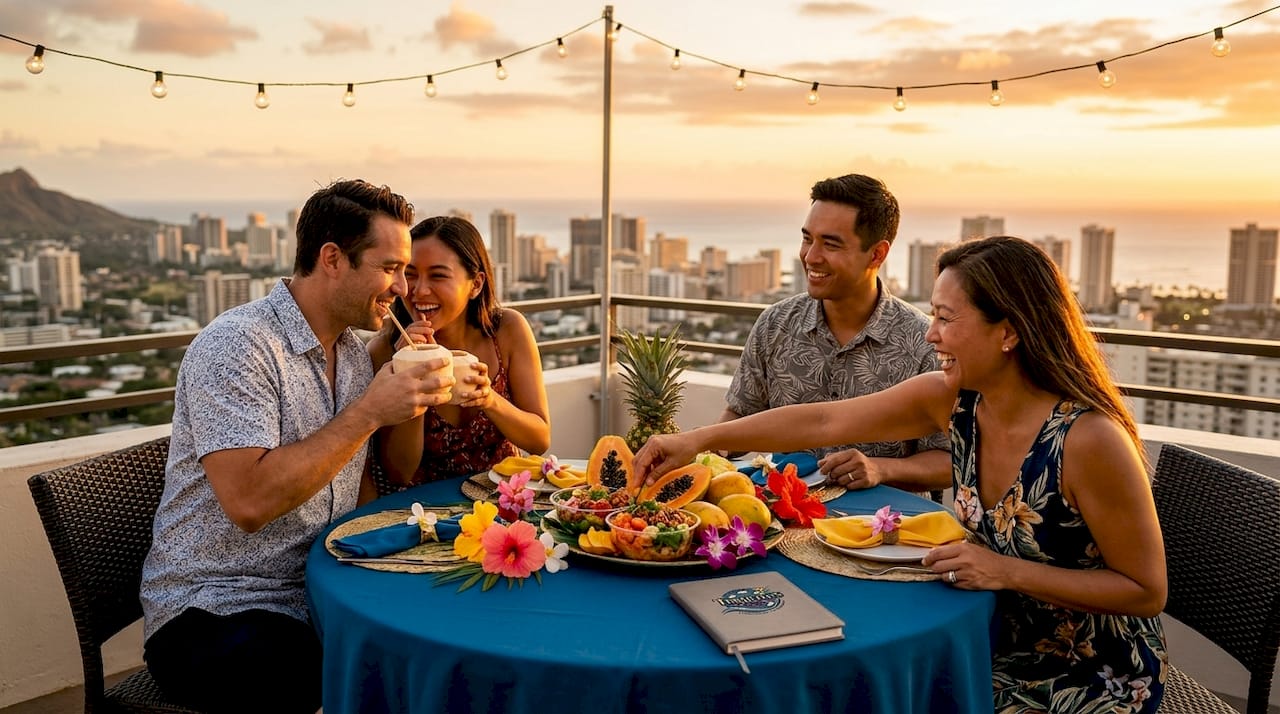
Physical gatherings promote social connection at a neurological level, improving the quality of team bonds in ways that virtual meetings simply cannot replicate. That means your layout, pacing, and entertainment choices are not decoration. They are strategy.
Here is what works for corporate event design:
Ditch the banquet rows. Cocktail-style or lounge groupings encourage movement and conversation. People connect when they can move around, not when they are locked into assigned seats facing a stage.
Vary your pacing. Different event formats need different energy rhythms. A two-hour session with no format change will lose the room. Alternate between presentations, group activities, and social time.
Integrate local culture. Oahu gives you something most event planners never get: a genuinely distinct cultural backdrop. Hawaiian music, local food vendors, lei greetings, and outdoor settings connected to the land add authenticity that attendees notice.
Invest in production quality. Good lighting transforms a generic hotel ballroom. Clean audio makes your speakers sound credible. These are not luxuries for big budgets. A modest investment in quality AV and lighting pays off in how the whole event feels.
For entertainment, karaoke and DJ-led activities work particularly well at team-building events and after-hours corporate receptions. They break down professional barriers fast. Check out these corporate event entertainment ideas if you are looking for specific formats that keep teams engaged throughout the night.
Pro Tip: Add one unexpected element — a photo booth, a live performer, an outdoor movie setup — that gives people something to talk about. The conversation that starts at the photo booth is often where the real networking happens.
Day-of execution and post-event follow-through
A well-designed event can still fall apart on the day if your execution plan is weak. Here is a numbered sequence for keeping things on track.
Build a minute-by-minute run-of-show. This document should include every segment, transition, and vendor cue. Share it across all vendors using a shared cloud folder so everyone works from the same version.
Assign one point of contact per vendor category. AV, catering, photography, and entertainment should each have a named contact on your team. Decision-making by committee on the day of an event is a recipe for delays.
Coordinate photography with a shot list. Oahu event photography coordination works best when you plan 3 to 6 months ahead, provide a detailed shot list, and align photo timing with your run-of-show. Your photographer cannot read your mind about which moments matter most.
Monitor sound levels throughout. Have someone on-site responsible for checking that amplified sound stays within Honolulu’s decibel thresholds and time restrictions. This is not just good practice. It is legally required.
Collect feedback within 24 hours. A short survey sent the morning after gets higher response rates than one sent a week later. Ask about energy, relevance, and what attendees want more of next time.
Pro Tip: After the event, schedule a 30-minute debrief with your internal team and pull three specific things to improve for next time. Teams that measure ROI iteratively consistently run better events year over year.
Quick-reference comparison of corporate event types
Use this table to match your objective with the right event format before you start planning logistics.
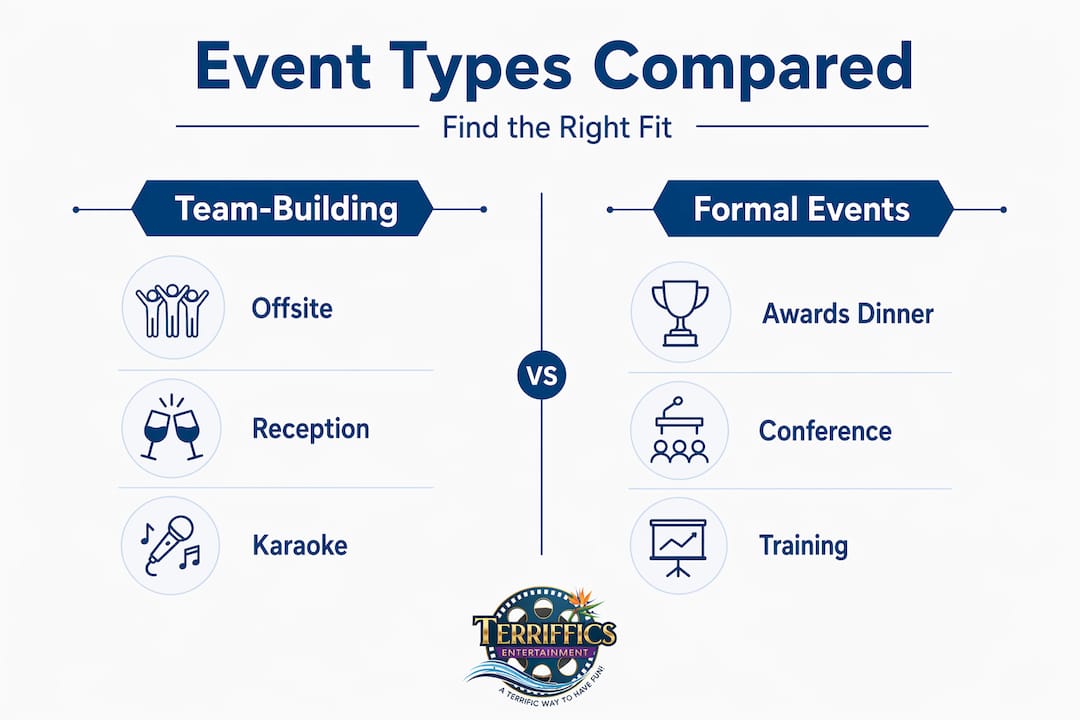
Event type | Primary purpose | Typical scale | Lead time needed | Key Oahu considerations |
Team-building offsite | Collaboration and trust | 10 to 100 people | 6 to 12 weeks | Outdoor permits, cultural integration |
All-hands meeting | Alignment and communication | 50 to 500 people | 4 to 8 weeks | AV compliance, indoor venue capacity |
Conference or summit | Networking and education | 100 to 1,000+ people | 12 to 18 months | Convention center booking, sound permits |
Awards ceremony | Recognition and morale | 50 to 300 people | 8 to 12 weeks | Staging, lighting, music curation |
Product launch | Excitement and visibility | 20 to 200 people | 8 to 16 weeks | Media access, entertainment production |
A few quick-reference reminders for Oahu planners:
Always confirm permit requirements before finalizing an outdoor venue
Book entertainment vendors early. Popular dates fill up fast during peak tourist and holiday seasons
Build cultural respect into your program, not just your catering menu
My take on planning corporate events in Oahu
I have seen planners spend weeks obsessing over centerpieces while never writing down what they actually want attendees to feel when they leave. That disconnect is where most corporate events lose their value.
In my experience working with corporate events on Oahu, the biggest unlock is not a better venue or a bigger budget. It is starting every conversation with “what do we want people to do differently after this event?” That one question changes how you design sessions, choose entertainment, set up the room, and measure success.
The noise regulation piece trips up a surprising number of businesses, especially those bringing mainland event partners who are not familiar with Honolulu rules. I have seen events get citations that were entirely avoidable with a single conversation with a local AV vendor upfront. Local expertise is not a nice-to-have in Oahu. It is protection.
And here is what I wish more planners would take seriously: the post-event measurement phase. Most teams celebrate a smooth event and move on. The ones who actually improve send the survey, review the data, and carry three specific lessons into the next event. That habit compounds. After two or three cycles, the events those teams run feel noticeably more intentional than anything their competitors produce.
Authentic cultural integration matters too. Not as a theme or a decoration choice, but as a genuine expression of respect for the place where you are gathering. When that shows up in your program, attendees feel it.
— Terriffics
Level up your next Oahu corporate event with Terriffics Entertainment
Planning a corporate gathering on Oahu is one thing. Making it genuinely fun and memorable is where Terriffics Entertainment comes in.
We are a Kapolei-based entertainment company serving the entire island. Our services include DJ sound and lighting, an AI-powered photo booth, karaoke, and outdoor movie setups. All of it is designed to fit neatly into your event timeline with fast setup, friendly service, and zero drama on the day. We work with corporate clients across Oahu to add the engagement layer that keeps guests talking long after the event ends. Browse our event setup gallery to see real examples from past corporate events. Ready to add a DJ, photo booth, or karaoke package to your next gathering? Let’s make it happen.
FAQ
What is the difference between a corporate event and a corporate gathering?
They mean the same thing. “Corporate gathering” is a descriptive phrase people use informally, while “corporate event” is the standard industry term used by professional planners and vendors.
How far in advance should you start planning a corporate event in Oahu?
Large conferences need 12 to 18 months of lead time, while smaller internal gatherings can be organized in 6 to 8 weeks. Oahu venues and popular local vendors book quickly, so earlier is always better.
Do you need a permit for amplified sound at a corporate event in Honolulu?
Yes. Amplified sound that is audible 30 feet away or exceeds 80 dBA at 30 feet requires a permit in Honolulu. Sound is also restricted between 9 PM and 7 AM for vehicles and certain outdoor setups.
What types of corporate events work best for team building in Oahu?
Team-building offsites and informal receptions with interactive entertainment, like karaoke, photo booths, or outdoor activities, are most effective. Oahu’s outdoor spaces and cultural assets make these events especially engaging compared to standard conference-room formats.
How do you measure the success of a corporate gathering?
Send a short feedback survey within 24 hours of the event and track specific metrics tied to your original goal, such as employee satisfaction scores, networking connections made, or alignment survey results. Teams that measure and iterate run consistently better events.
Recommended
Comments