
_edited.png)

Event Safety Explained: A Practical Guide for Planners


Event safety is the systematic process of identifying, managing, and mitigating risks to protect everyone at a gathering, from attendees and staff to vendors and performers. Most planners think about safety as a checklist item. The reality is that event safety explained properly covers health, security, crowd management, emergency response, and legal compliance working together as one system. Get any one of those wrong, and the others weaken. This guide gives you a clear, practical framework for understanding event safety and applying it to any celebration or gathering you plan on Oahu or anywhere else.
What are the essential components of event safety planning?
A comprehensive safety plan must include documented risk assessments, emergency procedures, and verified site walkthroughs before attendees arrive. That is the baseline. Without those three elements in writing, you are managing risk by guessing.
The risk management process follows four clear steps:
Hazard identification. Walk the venue and list every physical, environmental, and operational hazard. Think wet floors near a bar setup, extension cords across foot traffic paths, or a stage with no guardrail.
Likelihood and impact evaluation. Rate each hazard by how likely it is to occur and how serious the outcome could be. A loose cable near a DJ booth is high likelihood and high impact. A slightly uneven patch of grass in a low-traffic area is low on both.
Prioritization. Address high-likelihood, high-impact hazards first. Do not spend your first hour fixing a minor issue while a major one sits unresolved.
Documented mitigation. Write down what you did to address each hazard. This record protects you legally and helps your team act consistently.
Emergency procedures need to cover three core scenarios at minimum: medical incidents, fire, and severe weather. Each scenario should have a named person in charge, a communication method, and a clear evacuation route. Vague plans fail under pressure because people default to confusion when they have no specific instruction to follow.
Pro Tip: Walk the venue at the same time of day your event will run. Lighting conditions, crowd density, and vendor activity change how hazards look and behave.
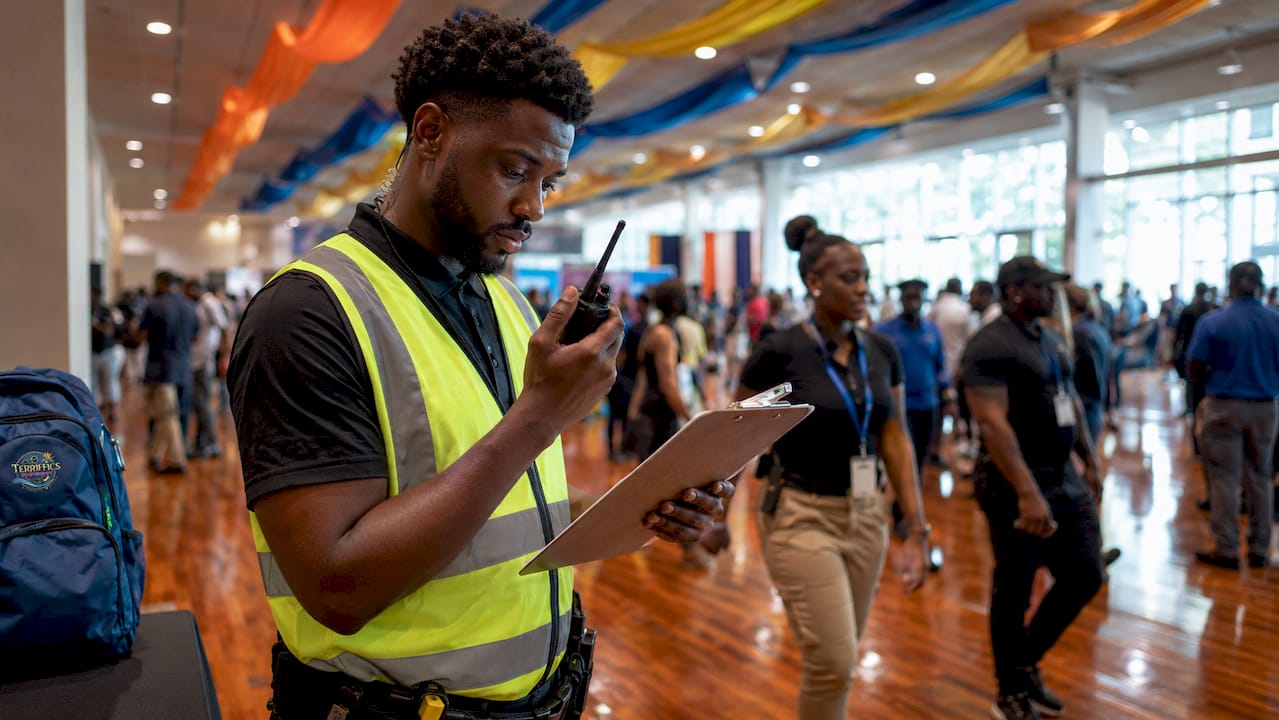
Real-time monitoring matters just as much as pre-event planning. Safety management is continuous, starting before attendees arrive and lasting through breakdown. Assign someone to actively monitor conditions throughout the event, not just check a box at the start.
How does layered event security differ from general safety measures?
Safety hazards and security threats are not the same thing. A safety hazard is accidental, like a spilled drink or a tripping risk. A security threat is deliberate, like an unauthorized person entering a restricted area or a confrontation between guests. Each requires a different response.
Modern event security uses a layered system that combines five functions: deterrence, detection, delay, response, and recovery. Here is how those layers differ from general safety measures:
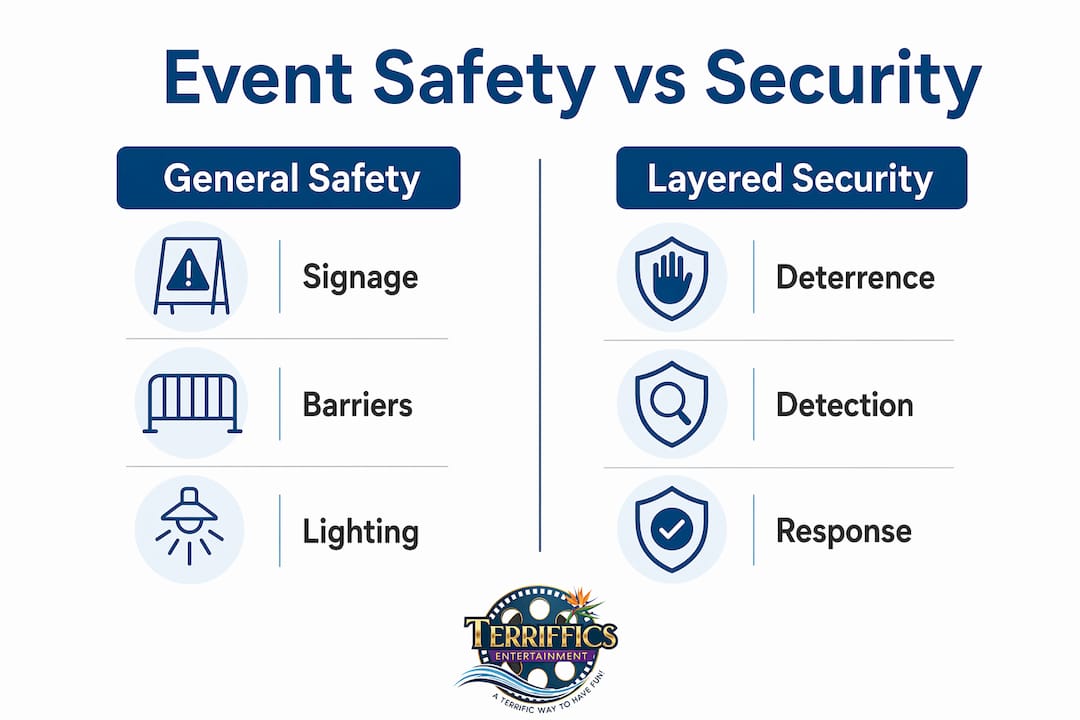
Layer | General safety focus | Security-specific focus |
Deterrence | Signage, barriers, lighting | Visible personnel, access checkpoints |
Detection | Hazard inspections | Surveillance, credential checks |
Delay | Slow hazard escalation | Restrict unauthorized movement |
Response | First aid, evacuation | Trained intervention, law enforcement contact |
Recovery | Incident documentation | Debrief, access log review |
Access control is the most underused tool at private events. Wristbands, guest lists, and designated entry points are not just for concerts. They work at birthday parties and corporate gatherings too, and they stop problems before they start.
Security presence should feel welcoming, not intimidating. Over-policing damages the guest experience. Under-planning creates real vulnerabilities. The goal is a visible but friendly presence that guests barely notice unless they need help.
Pro Tip: Brief your security team on the event’s tone before they arrive. A family graduation party calls for a very different approach than a large outdoor concert.
Why is accessibility a critical safety indicator?
Accessibility is not just compliance. It is a proactive crowd management factor that directly affects how safely people move through your venue. Wide corridors, clear sightlines, and logical traffic flow prevent bottlenecks. Bottlenecks turn routine evacuations into crises.
The Americans with Disabilities Act (ADA) sets the legal baseline for accessible design at public events. Meeting ADA standards is the floor, not the ceiling. Planners who treat accessibility as a safety tool, rather than a compliance box, build venues that work better for everyone.
Here is what accessible design does for your event safety:
Prevents crowd compression. Wide pathways give people room to move without pushing. Compression is one of the leading causes of crowd-related injuries at large events.
Speeds up evacuation. Clear, unobstructed exits mean people can move quickly when they need to. A hallway blocked by equipment or poor signage adds dangerous seconds to an evacuation.
Reduces confusion. Logical traffic flow, with clear entry and exit points, means guests know where to go without staff intervention.
Supports all attendees. Guests using wheelchairs, strollers, or mobility aids need the same access as everyone else. Designing for them benefits the entire crowd.
Tight hallways create bottlenecks that turn routine evacuations into crises. That is not a theoretical risk. It is a documented pattern from real incidents. When you plan your event layout, treat every corridor width and exit placement as a safety decision, not just a logistical one.
A practical test: stand at the main entrance and trace the path a guest in a wheelchair would take to reach the stage, the restrooms, and the nearest exit. If that path has obstacles, your safety plan has gaps.
How do legal compliance and documentation reduce liability?
Non-compliance with local safety laws leads to event cancellations and substantial fines. Planners who skip this step do not just risk a bad event. They risk losing the event entirely and facing legal consequences afterward.
The most common compliance requirements for events include:
Occupancy limits. Every venue has a legal maximum capacity set by fire codes. Exceeding it is a violation that can result in immediate shutdown.
Fire exit requirements. Exits must be clearly marked, unobstructed, and sufficient in number for the crowd size. Blocking an exit with equipment or décor is a code violation.
Alcohol service protocols. Licensed service, age verification, and responsible service training are legal requirements in most jurisdictions, not optional best practices.
Security staffing minimums. Some local governments require a minimum number of licensed security personnel based on event size and type.
Permits and notifications. Outdoor events, amplified sound, and large gatherings often require advance permits from local authorities.
Documented safety plans protect you in two ways. First, they demonstrate professional diligence if an incident occurs and a claim is filed. Second, they help you get permits approved faster because authorities can see you have thought through the risks. Real-time decision logs kept during the event are equally valuable. They show exactly what actions were taken and when, which is critical evidence if questions arise later.
What best practices ensure effective event safety execution?
Clear ownership of safety responsibilities is the single most important factor in effective execution. Diffuse accountability causes paralysis. When everyone is responsible, no one acts. Name specific people to specific roles before the event starts.
Effective execution relies on a few non-negotiable practices:
Assign named roles early. Designate a safety lead, a medical contact, a communications coordinator, and a vendor liaison. Each person knows their lane.
Rehearse responses, not just plans. Teams fall back on known behaviors under pressure. A plan that exists only on paper does not build the muscle memory needed to act quickly. Run a brief walkthrough with your team before guests arrive.
Use technology for real-time monitoring. Two-way radios, shared communication apps, and digital incident logs keep your team connected and create an automatic record of actions taken.
Monitor continuously through breakdown. Risk fluctuates during events based on crowd size, timing, and access control. The breakdown phase, when vendors are loading out and guests are leaving, is a high-risk window that many planners ignore.
Pro Tip: Create a one-page safety brief for every team member. It should list their role, their emergency contact, and the three actions they take if something goes wrong. Simple and fast to read.
An event planning checklist that integrates safety tasks alongside entertainment and logistics keeps everything in one place and prevents items from falling through the gaps.
Key Takeaways
Effective event safety requires documented planning, named accountability, accessible venue design, and continuous monitoring from setup through breakdown.
Point | Details |
Document everything | Written risk assessments, emergency procedures, and incident logs protect you legally and operationally. |
Name specific roles | Assign a safety lead and named contacts before the event to prevent decision paralysis during incidents. |
Treat accessibility as safety | Wide corridors and clear exits speed up evacuations and reduce crowd compression for all attendees. |
Layer your security | Combine deterrence, detection, and response functions rather than relying on a single security measure. |
Monitor through breakdown | Risk stays high during vendor load-out and guest departure, so keep your safety team active until the site is clear. |
Safety is part of the experience, not separate from it
Here is something I have seen planners get wrong repeatedly: they treat safety as a separate track from the event itself. They build a beautiful program, then bolt on a safety plan at the end like an afterthought. That approach fails because safety decisions affect every part of the event, from where you place the stage to how you route guests to the restrooms.
The planners who run the smoothest events think about safety from the first venue walkthrough. They ask, “What happens if we need to evacuate from this spot?” before they ask, “Does this spot look good on camera?” That shift in thinking changes everything.
Accessibility is where I see the biggest gap. Planners comply with ADA requirements on paper, then set up their event in a way that creates bottlenecks anyway. A compliant venue with poor layout is still a safety risk. Walk the space as if you are a guest with a stroller or a mobility aid. You will find problems that no checklist would have caught.
Clear ownership is the other piece most planners underestimate. I have watched well-prepared teams freeze during an incident because two people both thought the other one was in charge. Naming roles is not bureaucracy. It is the difference between a coordinated response and a chaotic one. Put names next to responsibilities before the event starts, and rehearse at least once. Your team will thank you when it matters.
The best events feel effortless to guests because the organizer did the hard work in advance. Safety is a big part of that invisible effort. When you get it right, nobody notices. When you get it wrong, everybody does.
— Terriffics
Trusted entertainment that takes safety seriously
Planning a safe event means choosing vendors who show up prepared, set up cleanly, and work within your venue’s safety parameters.
At Terrifficsentertainment, we bring our AI-powered photobooth rental to weddings, graduations, birthdays, and community gatherings across Oahu with fast setup, tidy cable management, and a team that coordinates with your safety lead before the event starts. We know how to fit our equipment into your venue layout without creating hazards or blocking exits. Every setup follows a clean, organized process so your guests have fun and your space stays safe. Ready to add a crowd-pleasing experience to your next event? Reach out to Terrifficsentertainment and let’s build something great together.
FAQ
What is event safety and why does it matter?
Event safety is the process of identifying and managing risks to protect attendees, staff, and vendors at any gathering. Without a documented plan, organizers face legal liability, potential shutdowns, and preventable injuries.
What should a basic event safety plan include?
A basic plan covers a written risk assessment, emergency procedures for medical incidents and evacuation, named safety roles, and a site walkthrough before guests arrive.
How does accessibility improve event safety?
Accessible venue design prevents crowd bottlenecks and speeds up evacuations by keeping corridors wide and exits clear. It benefits every attendee, not just those with mobility needs.
What are the legal risks of ignoring event safety compliance?
Non-compliance can result in event cancellation, substantial fines, and legal claims after an incident. Documented safety plans reduce liability by showing professional diligence.
How is event security different from event safety?
Event safety addresses accidental hazards like tripping risks or weather. Event security addresses deliberate threats using layered controls including access management, surveillance, and trained personnel response.
Recommended
Comments