
_edited.png)

Explaining Event Technology for Event Planners


Event technology is defined as the integrated suite of digital tools and platforms that manage every phase of event planning, execution, and analysis. Understanding event technology matters because it directly determines whether your event runs smoothly or falls apart under pressure. Around 25% of large enterprises spend over $250,000 annually on multi-solution stacks with six or more tools. That level of investment signals how central event tech has become to delivering measurable results. Whether you are planning a wedding in Kapolei or a corporate summit downtown, the right technology stack separates a forgettable event from an unforgettable one.
What are the core components of event technology?
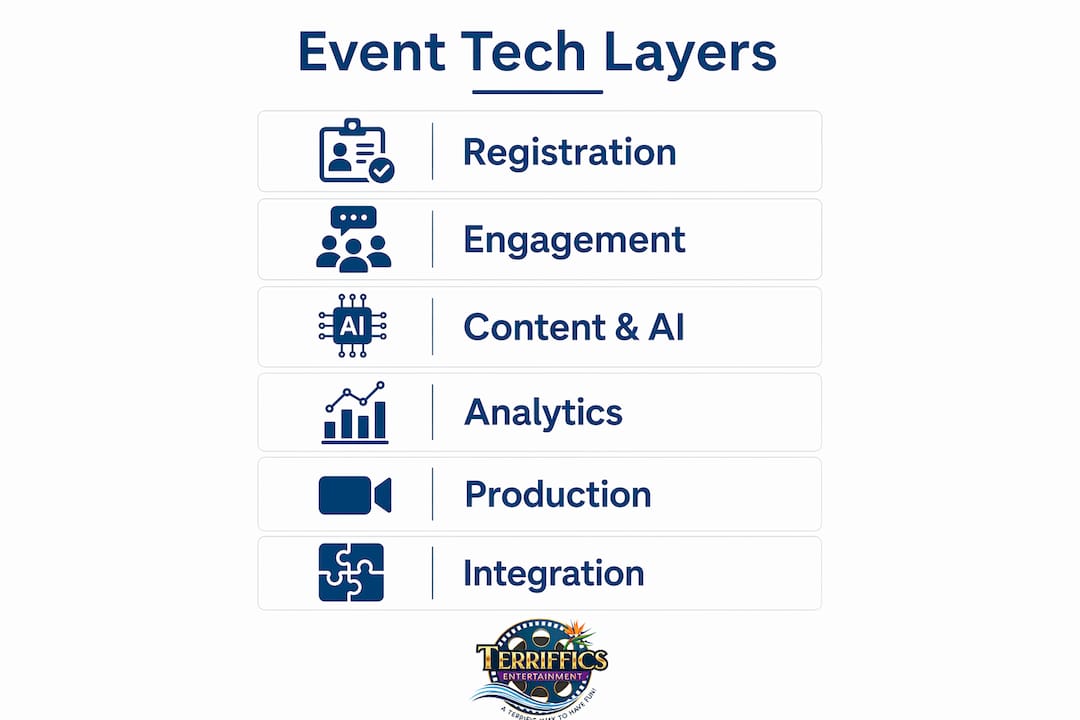
Event technology comprises six functional layers as of 2026: registration and ticketing, engagement, content and AI, analytics, streaming, and production hardware. Each layer handles a distinct job, and together they reduce manual work while generating data you can act on.
Layer | Primary Function | Common Tools |
Registration and ticketing | Collect attendee data, process payments | Online forms, ticketing platforms |
Engagement | Drive interaction before and during events | Mobile event apps, polling tools |
Content and AI | Capture, transcribe, and translate sessions | AI transcription, video recording |
Analytics | Measure attendance, behavior, and ROI | Dashboards, CRM integrations |
Streaming | Deliver content to remote audiences | Live streaming platforms |
Production hardware | Power the live experience | AV systems, lighting, sound rigs |
Registration and ticketing tools collect attendee data before the event even starts. That data feeds directly into your analytics layer, so you can segment audiences and personalize communications. Engagement tools like mobile event apps let attendees network, answer polls, and receive real-time schedule updates. They keep energy high and reduce the number of questions your staff fields on the day.

The content and AI layer is where event tech in modern events has advanced fastest. AI-powered content capture tools now consolidate transcription and translation into a single service while delivering real-time insights during sessions. That means a keynote speech can be transcribed, translated into multiple languages, and summarized for attendees within minutes of delivery. The analytics layer then ties all this activity to business outcomes, tracking which sessions drove the most engagement and which sponsors generated the most leads.
Production hardware sits at the base of everything. Sound systems, lighting rigs, and AV equipment are the physical layer that makes the digital experience real. You can learn more about how celebration technology shapes events and why each layer connects to the next.
How to choose the right event technology for your event
Choosing event technology starts with defining the specific job you need it to do. A tool that works brilliantly for a 5,000-person conference may be completely wrong for a 150-person graduation party. Before you evaluate any platform, write down your success metrics: registration volume, attendee satisfaction score, lead capture count, or post-event revenue attributed to the event.
A weighted scorecard system is the most reliable method for comparing vendors objectively. Assign each evaluation criterion a weight that adds up to 100 points, then score every vendor against those criteria. This removes gut-feel bias and gives you a defensible decision.
Follow these steps when selecting event technology:
Define the job. Write one sentence describing what the tool must accomplish and how you will measure success.
List your integration requirements. Identify every system the new tool must connect to, such as your CRM, email platform, or payment processor.
Score vendors on a weighted scorecard. Weight criteria by importance: integration reliability, support quality, pricing, and feature fit.
Test the integration points. Request a sandbox environment and run a full data transfer between systems before signing a contract.
Assess your team’s capacity. Calculate how many hours per week your team can dedicate to managing the tool and its integrations.
Calculate the real cost. Add tool licensing fees to the labor cost of managing integrations and troubleshooting failures.
The all-in-one versus best-of-breed debate has no universal answer. The right choice depends on your integration complexity and your team’s actual capacity to manage multiple systems. A small team planning community events on Oahu has very different needs from an enterprise marketing department running 50 events per year.
Pro Tip: Test every integration point in a live-like environment before you commit to a contract. Most technology failures happen at the handoff between systems, not inside the tools themselves.
What are the key event technology trends shaping 2026?
Event tech in modern events is shifting fast. The tools that defined events three years ago are already being replaced by AI-driven platforms and hybrid delivery models.
The top trends shaping event technology in 2026 include:
AI content capture: Real-time transcription, translation, and session summarization delivered during the event, not days later.
Hybrid event platforms: Single platforms that manage in-person and virtual attendees simultaneously, with unified analytics across both audiences.
Revenue attribution analytics: Dashboards that connect event activity directly to CRM pipeline data, showing which sessions influenced closed deals.
Platform consolidation: Event teams are reducing the number of tools in their stacks to lower integration risk and management overhead.
Personalization at scale: Registration data feeds automated email sequences and app experiences tailored to each attendee’s role and interests.
Security and data compliance: GDPR and CCPA compliance tools are now standard requirements, not optional add-ons.
Modern event success metrics are shifting from attendance counts to pipeline velocity and direct revenue attribution. That shift changes which tools matter most. An event with 200 attendees that generates $500,000 in pipeline outperforms a 2,000-person event that generates none. Your analytics layer needs to be built to capture that difference.
What practical challenges should event planners watch for?
The most common failure point in any event technology stack is the integration between systems, not the systems themselves. Most failures occur at integration joins where data passes from one tool to another. A registration platform that does not sync cleanly with your email tool means attendees receive duplicate messages or miss confirmation emails entirely.
Production hardware carries the highest risk of all. Most event stacks underweight live production technology even though it is the dominant risk and cost center for large events. A software glitch is recoverable. A failed sound system at a wedding ceremony is not. Read the event production complete guide to understand how production hardware fits into your overall planning.
The real cost of a multi-tool stack is not just the licensing fees. It includes the labor hours your team spends managing integrations, troubleshooting failures, and training new staff on each platform. Complex best-of-breed stacks can generate management overhead that outweighs their individual benefits.
Budget decisions that ignore hardware in favor of software features are a common mistake. Production technology failures are usually irrecoverable during a live event, which means they deserve the largest share of your risk assessment budget. Allocate contingency funds to backup AV equipment, redundant internet connections, and on-site technical support before you spend on premium software features.
Pro Tip: Run a full integration test at least two weeks before your event. Simulate the complete attendee journey from registration through check-in to post-event survey, and document every point where data moves between systems.
How does event technology enhance attendee experience?
Event technology improves attendee experience by removing friction at every touchpoint. Mobile event apps let attendees build personal schedules, message other guests, and receive push notifications when sessions change. That level of real-time communication reduces confusion and keeps energy focused on the event itself.
The benefits of event technology for attendee outcomes include:
Personalized agendas: Attendees select sessions based on their interests, and the app surfaces relevant content automatically.
Live polling and Q&A: Speakers receive audience questions in real time, making sessions more interactive and relevant.
Lead capture for sponsors: Digital badge scanning replaces paper business cards and feeds sponsor CRM systems instantly.
Post-event feedback loops: Automated surveys sent within 24 hours of the event capture honest responses while the experience is fresh.
Networking tools: AI-powered matchmaking connects attendees with shared interests or complementary business needs.
Integrating event analytics with CRM platforms lets your team track which attendees moved into active sales conversations after the event. That connection between event activity and revenue pipeline is what justifies the technology investment to leadership. Better outcomes come from targeted technology solving specific problems rather than accumulating features that no one uses. For events where entertainment is central to the experience, pairing the right tech with quality event sound systems makes a measurable difference in how attendees feel throughout the day.
Key Takeaways
Event technology works best when each functional layer is chosen to solve a specific problem, tested at every integration point, and supported by a team with the realistic capacity to manage it.
Point | Details |
Six functional layers | Every event tech stack covers registration, engagement, content, analytics, streaming, and production hardware. |
Weighted scorecard selection | Score vendors against weighted criteria to remove bias and make defensible technology decisions. |
Integration is the highest risk | Most failures happen at system handoffs, not inside individual tools, so test every connection before your event. |
Hardware deserves priority | Production hardware failures are irrecoverable during live events and should receive the largest risk budget. |
Metrics must tie to revenue | Track pipeline velocity and revenue attribution, not just attendance, to prove event ROI to stakeholders. |
What we have learned from watching planners get this wrong
Event technology decisions go sideways in a predictable pattern. A planner gets excited about a feature-rich platform, signs a contract, and then discovers the tool does not connect cleanly to their existing CRM. The workaround costs more in staff time than the tool itself saves.
The planners who get this right share one habit: they define the job before they evaluate the tool. They ask, “What specific problem does this solve, and how will I know it worked?” That question eliminates half the options immediately and makes the remaining evaluation much faster.
The other pattern I see constantly is underinvesting in production hardware while overspending on software. A beautiful event app means nothing if the sound system cuts out during the keynote. Hardware reliability is not glamorous, but it is what attendees remember. No one leaves a wedding talking about the registration platform. They leave talking about the music, the lighting, and the energy in the room.
My honest advice: build your stack from the production layer up, not from the registration layer down. Get the live experience right first. Then add the digital tools that make it measurable and repeatable.
— Terriffics
Terrifficsentertainment brings event technology to life on Oahu
Planning a celebration on Oahu and want technology that actually works on the day? Terrifficsentertainment blends professional entertainment with modern tech to create events your guests will talk about long after the last song plays.
Our AI-powered photobooth rental delivers instant, shareable photos that guests love and sponsors notice. We also provide DJ sound and lighting, karaoke, and outdoor movie setups, all with fast setup and friendly professional service across the entire island. Mix and match services to fit your event, your budget, and your vision. Reach out to Terrifficsentertainment today to get a custom quote for your next wedding, graduation, birthday, or corporate event.
FAQ
What is event technology?
Event technology is the integrated set of digital tools and platforms that manage registration, attendee engagement, content capture, analytics, streaming, and production hardware across an event’s full lifecycle.
How does event technology work?
Each tool in an event technology stack handles one functional layer, such as ticketing or analytics, and shares data with connected systems to give planners a unified view of event performance.
What are the biggest risks of using event technology?
The highest risk is integration failure at the handoff between systems. Production hardware failures, such as AV or sound outages, are the most damaging because they cannot be fixed during a live event.
How do I choose the right event technology for my event?
Define your success metrics first, then use a weighted scorecard to evaluate vendors on integration reliability, support quality, and feature fit before testing every system connection in a live-like environment.
Why does event technology matter for attendee experience?
Event technology removes friction through mobile apps, real-time polling, personalized agendas, and instant lead capture, which keeps attendees engaged and gives planners data to improve future events.
Recommended
Bài viết ngắn gọn, đi thẳng vào vấn đề nên đọc rất dễ, cảm ơn bạn đã chia sẻ. Mình thì ngày nào cũng hay xem thống kê XSMB để tiện theo dõi xu hướng, nên tự gom lại thành một trang tổng hợp cho đỡ phải lục nhiều nơi. Bạn nào cũng quan tâm số liệu cập nhật theo ngày thì ghé xem thử https://soicauxsmbpro.pixnet.net/blog